
Industrial Water Production. Anywhere.
Atmospheric Water Generation + Advanced Desalination Systems for Critical Infrastructure
Secure Your Water Resilience PlanAtmospheric Water Generation
On-site water production from air for inland, off-grid, and water-constrained environments.
Learn MoreDesalination & Water Recovery
Advanced desalination and produced water recovery systems for industrial and coastal operations.
Learn MoreDesalination & Water Recovery Systems
TEHP systems convert high-salinity and produced water streams into usable supply, reducing disposal costs and improving operational efficiency.
Designed for industrial environments, these systems enable water reuse, reduce dependency on external sources, and support long-term resilience.
Ideal for coastal facilities, produced water management, and high-volume industrial applications.
Explore Desalination Systems →Learn when desalination is the right approach for your operation.
What Is Atmospheric Water Generation?
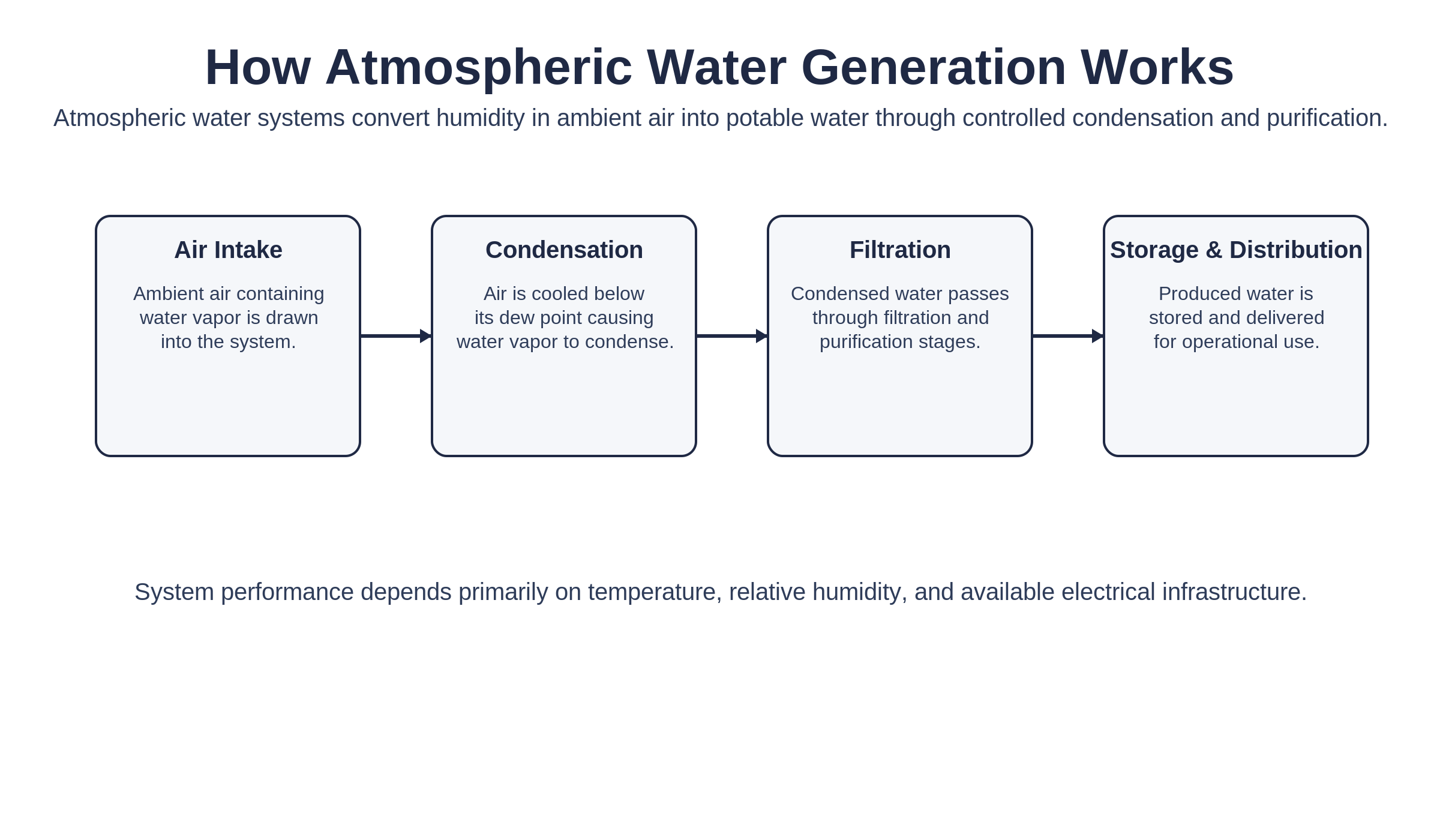
How Atmospheric Water Generation Systems Work
Clutch Critical Solutions deploys atmospheric water generation systems that convert ambient humidity into clean, potable water. These modular systems operate independently of traditional supply infrastructure, providing resilient on-site water production in constrained, remote, and mission-critical environments.
Air Intake & Filtration
Ambient air is drawn into the system and passed through multi-stage filtration components designed to remove particulates and environmental contaminants prior to condensation.
Condensation & Water Collection
The system cools air to its dew point, enabling moisture to condense into liquid water. Collected water is routed into internal storage for further treatment.
Purification & Mineralization
Generated water undergoes structured filtration and treatment processes, including purification and optional mineral balancing, to meet potable standards under defined operating conditions.
Deployment Requirements & Constraints
AWG deployment must be validated against site climate data, power availability, water quality requirements, and operational duty cycle. Planning should establish realistic production ranges and verification methods before procurement and commissioning.
Environmental Operating Envelope
System performance is directly correlated to ambient temperature, relative humidity, and elevation. Production output must be evaluated using historical climate data to establish expected seasonal ranges and minimum performance thresholds for the deployment region.
Electrical Load & Power Quality
AWG systems require stable electrical input sized to compressor load, controls, and ancillary treatment components. Deployment planning should verify service capacity, voltage stability, backup power strategy, and load prioritization within the facility’s electrical architecture.
Production Planning & Storage Buffering
Production capacity must be aligned with defined demand profiles, redundancy requirements, and storage buffering strategy. AWG is most effective when deployed as a supplemental water asset within a broader resilience framework rather than a single-point dependency.
Controls, Monitoring & Oversight
Deployment requires coordination across facility engineering, utility stakeholders, and compliance authorities. Integration planning should address monitoring visibility, performance reporting, maintenance access, and alignment with applicable regulatory and water quality standards.