
Integrated Water Resilience Systems for Infrastructure-Constrained Environments
Deployable and fixed atmospheric water generation (AWG) systems designed for industrial facilities, municipalities, and emergency response environments where conventional water supply is unreliable or unavailable.Production output is determined by local temperature, humidity, and available power infrastructure. Clutch evaluates site conditions and deploys systems configured for real-world operating constraints.
Secure Your Water Resilience PlanWhat Is Atmospheric Water Generation?
Where Atmospheric Water Generation Is Being Deployed
Atmospheric water generation systems are deployed in environments where conventional water infrastructure is constrained, unreliable, or operationally impractical.
Organizations are incorporating AWG technology into resilience planning, emergency preparedness programs, and remote operations that require dependable on-site water production independent of municipal supply systems.
• Disaster Response and Humanitarian Operations — Deployable AWG systems can produce potable water when infrastructure is damaged or unavailable following natural disasters.
• Remote Industrial Operations — Mining, energy, and infrastructure projects in remote locations use atmospheric water systems to reduce reliance on transported water supplies.
• Municipal Resilience Programs — Cities and counties are evaluating distributed water production technologies as part of long-term resilience planning.
• Data Centers and Critical Infrastructure — Data centers, industrial facilities, and mission-critical operations are increasingly assessing alternative water sources to support operational continuity.
What Determines Atmospheric Water Generation Output
Key environmental variables
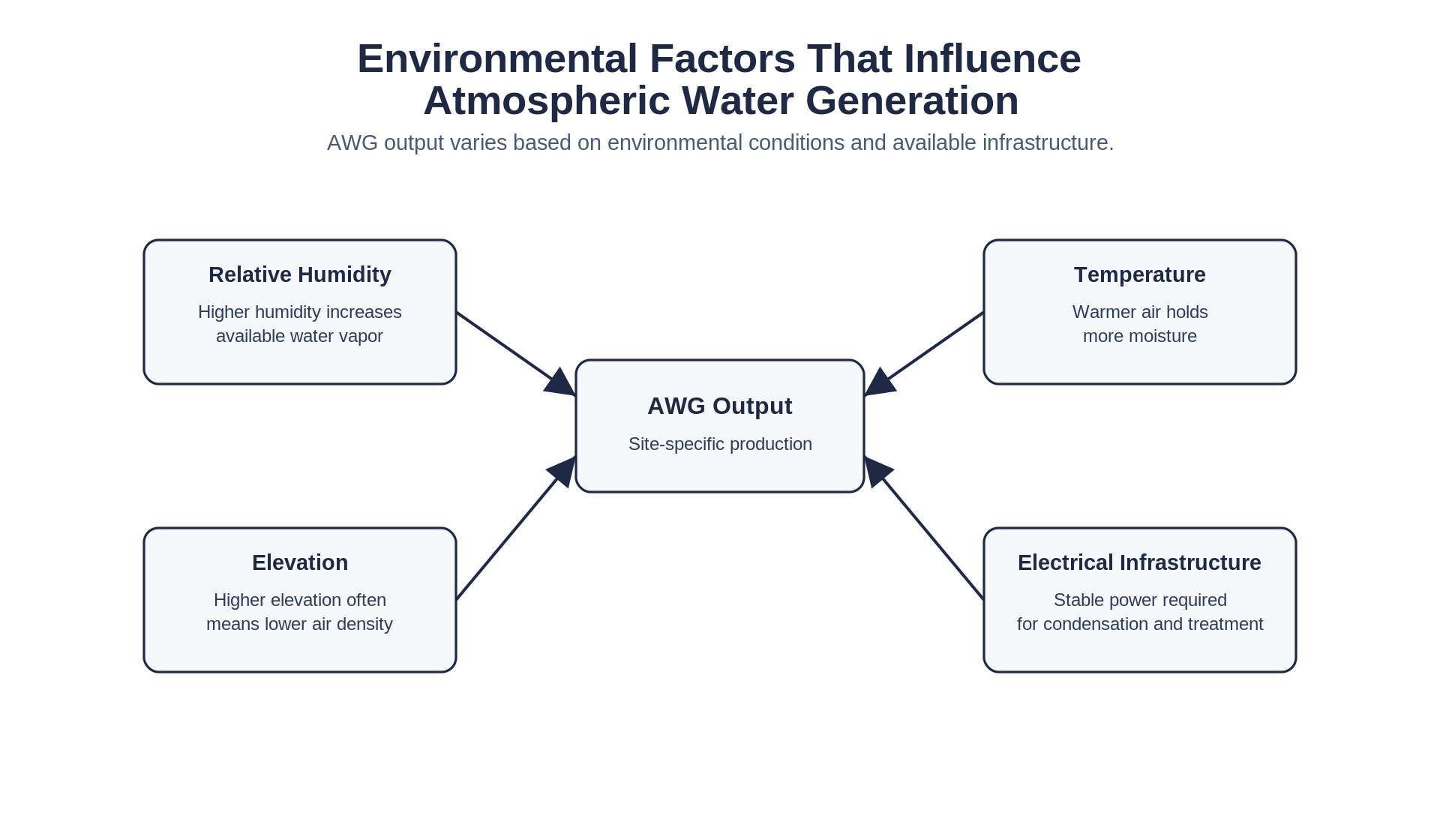
- Relative Humidity — Higher humidity increases the amount of water that can be condensed from ambient air.
- Temperature — Warmer air can hold more moisture, improving potential water yield.
- Elevation — Higher elevations generally have lower atmospheric pressure and lower absolute humidity.
- Electrical Infrastructure — AWG systems require reliable electrical supply to operate condensation and purification systems.
Typical AWG Production Ranges
- Portable / Rapid Deployment Units
20–500 liters per day. Used for emergency response teams, field operations, and temporary water supply. - Facility Support Systems
500–5,000 liters per day. Suitable for remote facilities, small industrial operations, and resilient building infrastructure. - Industrial-Scale Systems
5,000–50,000+ liters per day. Designed for industrial sites, data centers, and large facilities seeking partial water independence. - Modular Deployment Arrays
Multiple systems deployed in parallel to support municipal resilience programs, disaster response logistics, or large industrial demand.
Integrated Water Resilience Solutions
Comprehensive water security systems engineered for operational continuity in high-risk and infrastructure-stressed environments.
Atmospheric Water Generation Systems
Modular atmospheric water systems engineered to provide decentralized, infrastructure-independent water production in constrained and crisis-prone environments.
Rapid Deployment Water Infrastructure
Mobile and modular water resilience systems designed for accelerated deployment in crisis response, industrial expansion, and infrastructure failure scenarios.
Integrated Resilience Planning & Support
Strategic implementation support, capacity modeling, and integration planning to ensure sustainable water security within existing operational frameworks.
Operating in High-Risk and Constrained Environments
We support organizations operating in environments where water availability, infrastructure reliability, and continuity risk have direct operational and public impact. Our focus is on supplemental, deployable systems structured around defined constraints and real-world conditions.
Municipal and Public Infrastructure
Deployable atmospheric water generation systems provide decentralized production capabilities for municipalities facing drought, infrastructure degradation, or emergency disruption.
Industrial and Mission-Critical Facilities
On-site water generation reduces dependency on vulnerable external supply chains, protecting operational continuity for data centers, manufacturing, and industrial facilities.
Disaster Response and Rapid Deployment
Mobile and modular AWG systems provide immediate water production capability for emergency response, humanitarian operations, and temporary infrastructure stabilization.
How Atmospheric Water Generation Systems Work
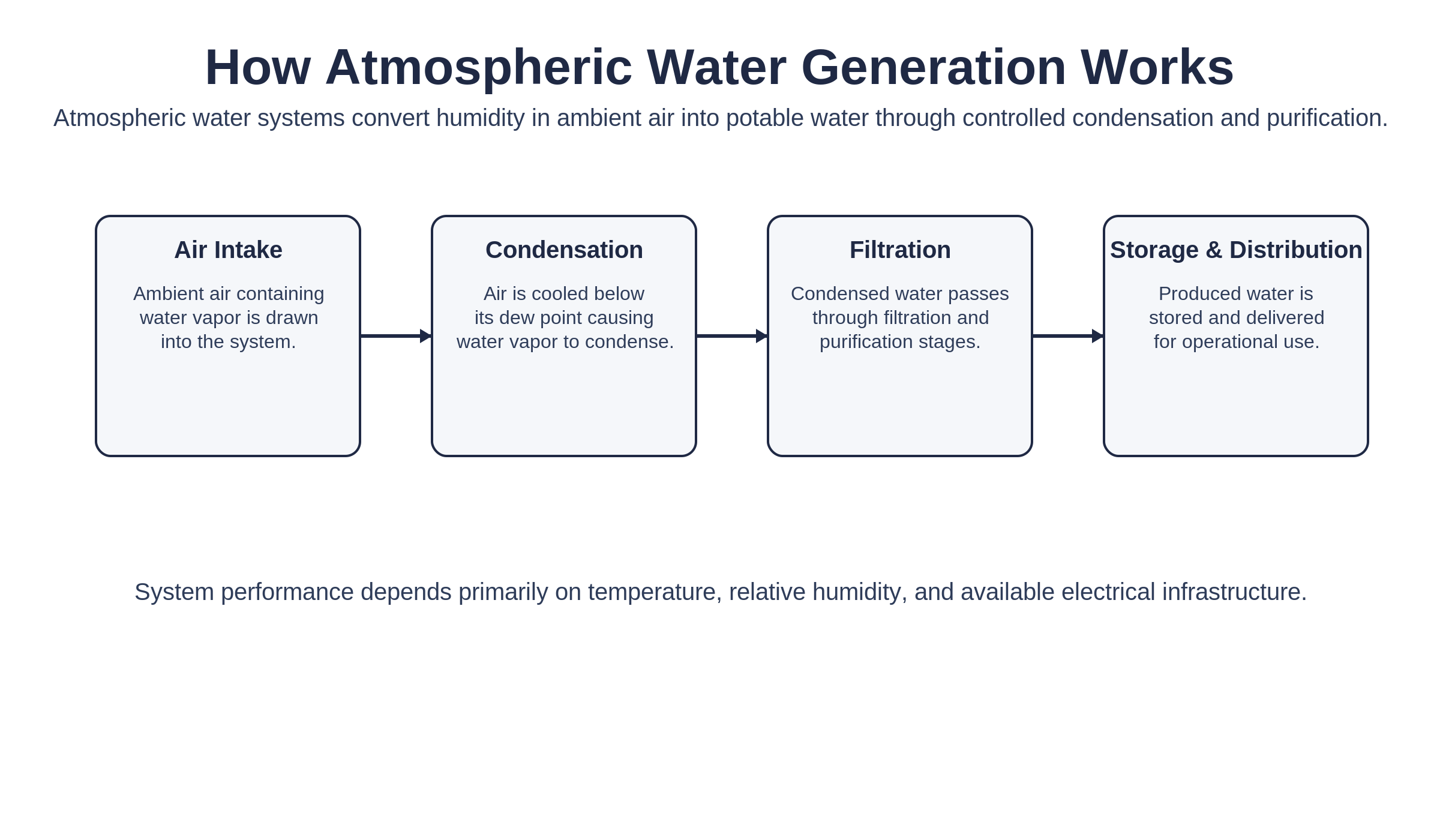
Clutch Critical Solutions deploys atmospheric water generation systems that convert ambient humidity into clean, potable water. These modular systems operate independently of traditional supply infrastructure, providing resilient on-site water production in constrained, remote, and mission-critical environments.
Air Intake & Filtration
Ambient air is drawn into the system and passed through multi-stage filtration components designed to remove particulates and environmental contaminants prior to condensation.
Condensation & Water Collection
The system cools air to its dew point, enabling moisture to condense into liquid water. Collected water is routed into internal storage for further treatment.
Purification & Mineralization
Generated water undergoes structured filtration and treatment processes, including purification and optional mineral balancing, to meet potable standards under defined operating conditions.
Deployment Requirements & Constraints
AWG deployment must be validated against site climate data, power availability, water quality requirements, and operational duty cycle. Planning should establish realistic production ranges and verification methods before procurement and commissioning.
Environmental Operating Envelope
System performance is directly correlated to ambient temperature, relative humidity, and elevation. Production output must be evaluated using historical climate data to establish expected seasonal ranges and minimum performance thresholds for the deployment region.
Electrical Load & Power Quality
AWG systems require stable electrical input sized to compressor load, controls, and ancillary treatment components. Deployment planning should verify service capacity, voltage stability, backup power strategy, and load prioritization within the facility’s electrical architecture.
Production Planning & Storage Buffering
Production capacity must be aligned with defined demand profiles, redundancy requirements, and storage buffering strategy. AWG is most effective when deployed as a supplemental water asset within a broader resilience framework rather than a single-point dependency.
Controls, Monitoring & Oversight
Deployment requires coordination across facility engineering, utility stakeholders, and compliance authorities. Integration planning should address monitoring visibility, performance reporting, maintenance access, and alignment with applicable regulatory and water quality standards.